India captain Shreyas Iyer discusses team’s adaptation issues after series loss to England


India’s struggles in England
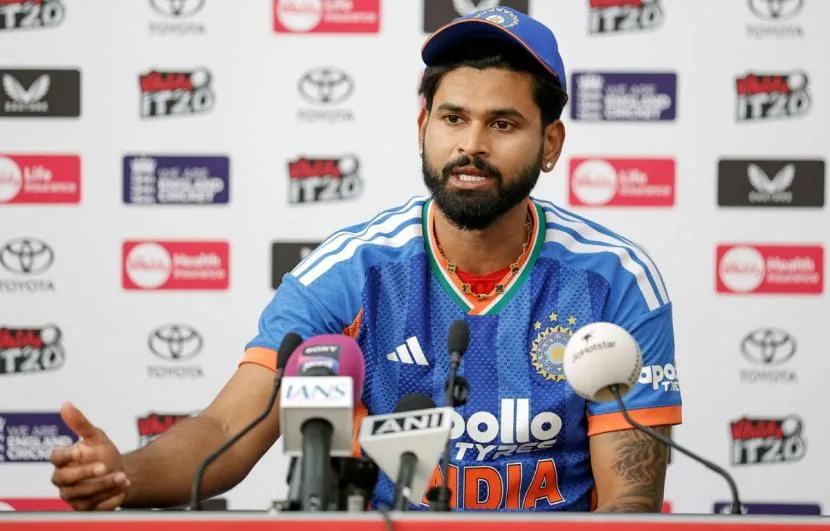
India captain Shreyas Iyer has acknowledged his team’s difficulties in adapting to varying playing conditions, alongside fielding errors and a failure to establish batting partnerships, as primary factors contributing to their performance in England. The team experienced a 4-0 whitewash in the T20I series against England, culminating in a 56-run defeat in the fifth and final match held in Southampton.
The series saw England secure a comprehensive sweep, which also propelled them to the World No. 1 ranking in ICC T20I cricket. The first match of the series, scheduled at Chester-Le-Street, Durham, was abandoned due to rain, setting the stage for the subsequent matches where India faced consistent challenges.
In the final T20I, England set a formidable target of 257 for 3. Despite the pitch being described as the best batting wicket of the series, India struggled to recover after losing wickets in clusters during their chase. This pattern of losing multiple wickets in quick succession was a recurring issue throughout the series.
Iyer’s post-match reflections
Following the final match, Shreyas Iyer commented on the team’s performance, stating, “We have a lot to take out of the series. Conditions, awareness, adaptation. This was the best wicket we played on, the approach was different when we batted. Conditions kept changing from match one. We need to be aware and adapt as professionals.”
He further elaborated on the team’s shortcomings, highlighting fielding lapses and the inability to build crucial partnerships during chases. “Important to communicate what we could have done better. Fielding plays a key role and we need to work on it. Especially overseas, with different dimensions in grounds. We dropped catches which cost us. 220-225 we might’ve chased down but not to be.”
Iyer also pointed out the issue of losing wickets in clusters, which hampered their ability to maintain momentum. He noted that the team was often focused on chasing the target aggressively rather than establishing partnerships, which he believes is essential for successful chases. He also praised England’s execution, specifically mentioning Jos Buttler’s performance and Harry Brook’s ability to change the momentum of the game.
England’s dominant performance
England’s success in the series was significantly bolstered by strong individual performances. In the final T20I, a 233-run partnership between captain Harry Brook and Jos Buttler was pivotal, effectively taking the game away from India. Brook, who was named ‘Player of the Series’, expressed his satisfaction with England’s all-round display that secured both the series sweep and the No. 1 ranking.
Brook scored an unbeaten 95 off 45 balls in the final match and commented on his approach, stating, “We had a lot of fun. Ran well, hit boundaries and complemented each other. We were just trying to get ourselves to get in the best position we could. Cricket is a simple game we complicate. Just watched the ball and played the best shot for it. I’m striking the ball nicely.” He also lauded the team’s spinners for their effective performance compared to their Indian counterparts.
Jos Buttler, who was named ‘Player of the Match’ for his 64-ball 131, expressed delight at rediscovering his form after a lean period. He attributed his return to form to his performance in the IPL and the motivation of playing for England. Buttler praised Brook’s ability to put pressure on opposition bowlers and highlighted the collective effort behind England’s dominant series triumph, calling the 4-0 win against India a significant achievement.
Transition phase and lessons learned
Earlier in the series, after England secured an unassailable 3-0 lead with a nine-wicket victory in the fourth T20I at Bristol, Shreyas Iyer had described the India team as being in a “transition phase.” He suggested that mistakes were inevitable as several young players adapted to overseas conditions for the first time. This explanation, however, has been met with varied opinions, especially since India are the defending T20 World Cup champions and have retained a core of experienced players.
Despite the presence of youngsters like Vaibhav Sooryavanshi and Prince Yadav, the team still includes several experienced players. Iyer maintained that learning quickly from these mistakes would ultimately benefit the team. He expressed confidence that the players are quick learners and would assess themselves to improve in future matches.
In the Bristol match, Iyer was the sole bright spot for India with the bat, scoring an unbeaten 80 while the rest of the batting lineup struggled against England’s pace attack. He admitted that his individual performance held little significance in a losing cause. India posted 158 after an underwhelming batting display, a total that Harry Brook and Phil Salt chased down in just 13.5 overs with an unbeaten 146-run stand. Iyer conceded that 158 was not a competitive total and that India’s bowlers failed to execute their plans consistently, particularly in maintaining consistent lengths after an encouraging start.
The series concluded with England’s commanding nine-wicket victory in the fourth match at the County Ground, Bristol, securing their first-ever bilateral T20I series triumph over India in a series of two or more matches, while India suffered their second consecutive bilateral T20I series defeat.
Read Also
- Sinner and Zverev to meet in Wimbledon final after Djokovic exit
- Ferran Torres could depart Barcelona for Paris Saint-Germain
- Rudi Garcia faces scrutiny after Thibaut Courtois substitution in Belgium's World Cup loss
- Granit Xhaka expected to start for Switzerland against Argentina in World Cup quarterfinal
Source: m.rediff.com

