Brendon McCullum Apologizes for England Test Performance After Sacking

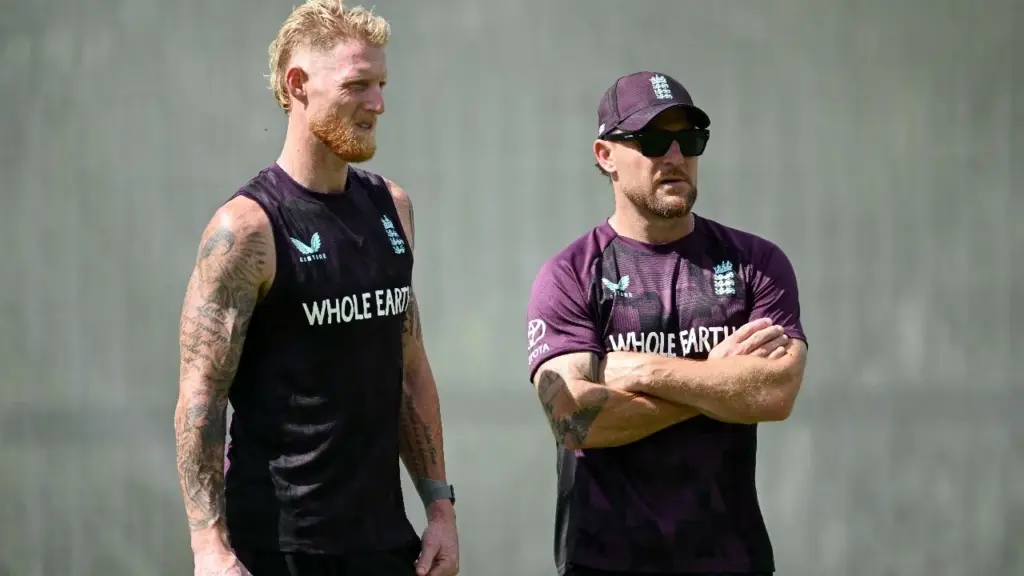
Brendon McCullum has issued an apology for the performance of the England Test team during his tenure as head coach, following his dismissal on Sunday. McCullum acknowledged that the team’s results, particularly in marquee series against Australia and India, were not sufficient. He will continue as head coach for England’s white-ball teams, with a contract extending until the conclusion of the 50-over World Cup in southern Africa in the autumn of 2027.
McCullum stated that in a results-driven business, the team did not achieve the desired outcomes, for which he expressed regret. He highlighted that not winning against India and Australia meant failing to achieve the primary objectives. While acknowledging some positive achievements over four years, he admitted that results at the end of his term did not meet expectations, leading to the decision.
The departure of McCullum follows a period of decline for the England Test team. His sacking occurred two weeks after former captain Ben Stokes announced his retirement from international cricket. The downturn, often associated with the ‘Bazball’ approach, began with a 4-1 Ashes defeat in Australia. Despite this, McCullum, Stokes, and director of cricket Rob Key initially retained their positions.
Performance and Accountability
A 2-1 series defeat at home against New Zealand marked a turning point, leading first to Stokes’s retirement and then McCullum’s dismissal. Key remains in his role, having received long-term support from England and Wales Cricket Board (ECB) chief executive Richard Gould.
McCullum reflected on the Australian series, stating that the team did not achieve the desired outcome. He mentioned subsequent efforts to implement changes and new tactics. The defeat by New Zealand added further pressure due to the results. McCullum accepted responsibility, stating that someone had to be accountable, and he would take that responsibility.
The later stages of McCullum’s coaching period were also affected by off-field incidents. During the winter, players Harry Brook, Jacob Bethell, Josh Tongue, and Ben Duckett were involved in late-night events. Following England’s victory in the first Test of the summer against New Zealand, the series was disrupted when Stokes and Gus Atkinson breached the team’s midnight curfew, being present during an incident involving a security staff member and a Saracens rugby player.
McCullum took responsibility for both on-field and off-field issues. He affirmed his leadership role in the team’s culture, tactics, and results. He acknowledged that in a results-oriented environment, a lack of results leads to replacement, a situation he is familiar with from his extensive career in the sport. He accepted that the performance was not good enough.
Both McCullum and Stokes had previously denied any growing distance between them during the Ashes series. McCullum confirmed receiving messages from Stokes following the news of his departure from the Test role. He remarked on the symbolic nature of their simultaneous exit, having started together.
The ‘Bazball’ Era and Its Limitations
The ‘Bazball’ philosophy, introduced by McCullum, aimed to revolutionise England’s Test cricket with an aggressive, fearless approach. Initially, this strategy yielded immediate success. England achieved a 55 per cent win rate, securing twenty-seven wins in forty-nine Tests, and rose to second in the ICC rankings. The term ‘Bazball’ entered the Collins dictionary.
Early successes included a clean sweep against New Zealand in June 2022, victories against India at Birmingham, a whitewash of Pakistan, and a win in New Zealand. These results fostered a belief in the effectiveness of the approach.
However, the 2023 Ashes series at home revealed vulnerabilities. Australia’s pace attack challenged the ‘Bazball’ strategy, with England losing the first two Tests at Birmingham and Lord’s. Although England fought back to draw the series 2-2, Australia retained the Urn, indicating that the aggressive approach was susceptible to elite pace bowling.
The tour of India in early 2024 marked a significant setback. After winning the first Test in Hyderabad, England lost the series 1-4, as Indian bowlers like Ravichandran Ashwin effectively countered England’s aggressive batting. A subsequent tour of Pakistan saw a similar pattern, with England losing after an initial win, particularly on spin-friendly pitches.
The home series against India also demonstrated the limitations, with India drawing the series 2-2, their best result in England since 2007. The final verdict on the ‘Bazball’ approach came in the pink ball Test in Australia, where England lost the series 1-4, with Australia retaining the Urn.
Against India and Australia combined, England won only four Tests and lost eleven, with series records including 1-4 in India, 2-2 at home against India, 2-2 in the home Ashes, and 1-4 away. While the ‘Bazball’ approach was effective against other teams, it struggled against top-tier bowling attacks, particularly away from home, where the win rate declined significantly. The ECB eventually sacked McCullum.
Future Leadership and Upcoming Fixtures
The search for a new Test coach for England is now in progress. Gould indicated that a new coach would be appointed before a new captain is finalised. He also suggested a split captaincy, which could imply that white-ball captain Brook, who is also the Test vice-captain, might not lead across all formats.
McCullum and Brook have developed a strong working relationship within the white-ball teams, with England’s T20 side currently holding the top spot in world rankings. This raises questions about the future of this partnership if Brook assumes leadership of the Test side. McCullum expressed his high regard for Brook as a player, person, and leader, noting his tactical acumen and rapid development as a leader. He hopes to continue working with Brook.
McCullum has prior experience with split coaching responsibilities, having served as Test coach while Matthew Mott managed the white-ball teams. After Mott’s dismissal, McCullum took overall control. The congested cricket schedule often necessitates splitting coaching roles, though this can also lead to challenges in player access for multi-format players.
McCullum will need to establish a working relationship with the incoming Test coach. Potential candidates for the Test coaching role include former England coach Andy Flower, McCullum’s former New Zealand team-mate Stephen Fleming, who recently left Indian Premier League side Chennai Super Kings, former England batter Jonathan Trott, and Glamorgan coach Richard Dawson.
England, under McCullum’s continued leadership for white-ball cricket, is scheduled to play a three-match one-day series against India.

Jos Buttler is set to play his 200th ODI for England in the upcoming series, while India’s squad will feature players such as Virat Kohli, Rohit Sharma, and Jasprit Bumrah.
Read Also
Source: bbc.com

