Top four ranked teams reach World Cup 2026 semifinals for the first time


Four top-ranked teams advance
The World Cup 2026 semifinals will feature the four highest-ranked teams globally: Spain, Argentina, France, and England. This marks the first occasion since the introduction of FIFA rankings that the top four teams have all reached this stage of the tournament. The semi-final matchups will see France play Spain and England face Argentina.
This outcome is partly due to a new draw system implemented by FIFA for the 2026 tournament. The system was designed to prevent these top-ranked teams from meeting each other in the earlier knockout rounds. Spain and Argentina were placed in opposite halves of the draw, as were France and England, with each occupying a separate quarter of the knockout bracket. This arrangement ensured that, provided they won their respective groups, none of these teams could face another member of the top four before the semifinals.
New FIFA pairing system
The new pairing system utilized FIFA rankings to separate the tournament’s four leading seeds across the knockout bracket. Spain, ranked No. 1 when the draw was made, was paired with No. 2 Argentina and placed in opposite halves, meaning they could not meet before the final. Similarly, third-ranked France and fourth-ranked England were also placed on opposite sides. This ensured that the four teams entered separate quarters of the bracket and could not meet prior to the semifinals, assuming each won its group.
This approach is similar to how leading seeds are separated in tennis draws. FIFA did not predetermine match results or select opponents directly, but it did determine which section of the bracket each top seed would enter as a group winner. The organization described this arrangement as creating “two separate pathways to the semi-finals.” This is a novel approach for the men’s World Cup, though a similar principle was used in the 2025 Club World Cup.
The protection offered by this system was contingent on the top teams winning their groups. For instance, if Spain had finished second in its group while Argentina still won theirs, they could have met in the first knockout round instead of being kept apart until later stages. England also needed to win their group to maintain their protected route; a second-place finish could have led to an encounter with Spain as early as the round of 16.
All four teams successfully won their groups, preserving the routes FIFA had established for them. They then navigated three knockout rounds. Argentina defeated Cape Verde, Egypt, and Switzerland. Spain overcame Austria, Portugal, and Belgium. France triumphed over Sweden, Paraguay, and Morocco. England advanced past DR Congo, Mexico, and Norway.
Historical context and rivalries
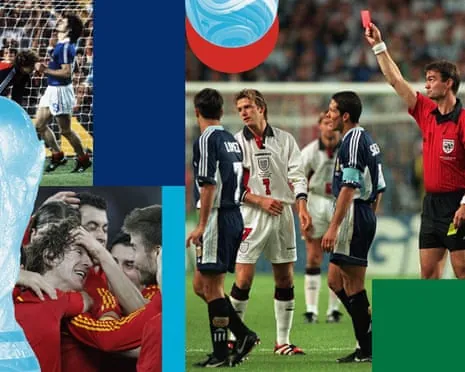
The scarcity of matches in the World Cup means each game carries significant weight, contributing to a rich history that influences current perceptions. This psychological aspect plays a more substantial role in World Cup football than in other forms of the game. Countries often find themselves playing against the “ghosts of their own past,” with historical moments becoming cultural touchstones.
Spain has a limited history in World Cup semifinals, having only played in one previously, which they won 1-0 against Germany in 2010. This was achieved through a controlled performance, culminating in a 73rd-minute header by Carles Puyol. Despite their strong record in the latter stages of European Championship tournaments, including winning five of six major finals they reached, their only final loss was to France in 1984, who they will face in Tuesday’s semifinal. They also lost to France in a memorable Euro 2000 quarter-final.
France also carries its own historical burdens, particularly from semifinals. The 1982 game in Seville against West Germany is considered a traumatic event in their footballing history, marked by a severe unpunished foul on Patrick Battiston. Despite taking a 3-1 lead in extra-time, France eventually lost in the World Cup’s first penalty shootout. They lost to West Germany again in the semifinal four years later. While three subsequent semifinal successes may have eased some anxieties, historical demons can resurface.
The rivalry between England and Argentina is particularly intense, steeped in a long history of significant encounters. These range from Bobby Charlton’s goal in 1962 and the sending off of Antonio Rattín in 1966, to the “Hand of God” incident in 1986, David Beckham’s red card in 1998, and Michael Owen’s collapse over Mauricio Pochettino’s leg in 2002. Their last meeting in 2005 in Geneva, though a friendly, was a remarkable game where Michael Owen scored two goals in the final five minutes to secure a victory for England after Juan Román Riquelme had seemingly inspired Argentina to victory.
While the animosity might have lessened somewhat over time, especially with Argentinians being prominent in the Premier League and the passage of time since the Falklands conflict and the “Hand of God,” the rivalry’s roots run deep. England also faces its own semifinal traumas, including the penalty shootout defeat to West Germany in 1990 in Turin and the collapse against Croatia in 2018 in Moscow. In the current tournament, England has addressed some of its past by winning at the Azteca, and the next challenge is to defeat Argentina in a knockout game.
The expansion of the World Cup from 32 to 48 teams changed the competition’s structure, introducing 12 groups, eight third-place qualifiers, and an additional round of 32. This new format meant that two group winners could potentially meet in the round of 16, which occurred three times in this tournament. The special placement of the four highest-ranked sides aimed to prevent such early encounters between top teams, provided they won their groups, thereby maintaining “competitive balance” and increasing the likelihood of marketable teams reaching the final stages.
Read Also
Source: theguardian.com

